The Solar Battery Rebate Isn't Ending. But Your Best Price Is.
From 1 May 2026, the federal government is restructuring how rebates are calculated, and for many Australian households, that means the deal gets significantly worse. Here's what's changing, who it affects, and why the next few weeks matter.
If you've been sitting on the fence about installing a solar battery, you've probably seen the headlines: rebate changes coming in May. Some sites are calling it the end of the program. Others say nothing's changing. The truth sits somewhere in the middle, and for a meaningful slice of Australian homeowners, it's worth paying close attention to right now.
Let's cut through the noise.
No, the rebate isn't ending
The federal government's Cheaper Home Batteries Program is funded and legislated to run until 2030. It's not going anywhere. In fact, the government recently expanded the program from $2.3 billion to an estimated $7.2 billion, with a goal of supporting over two million Australian battery installations by the end of the decade.
So if someone tells you the rebate is disappearing in May, that's not accurate.
But something is changing, and for many households, it's significant.
What's actually changing on 1 May
Right now, the rebate is calculated evenly across your battery's full usable capacity. From 1 May, a tiered system kicks in. The more capacity you install, the less generous the rebate becomes per kilowatt-hour.
Here's how the new tiers work:
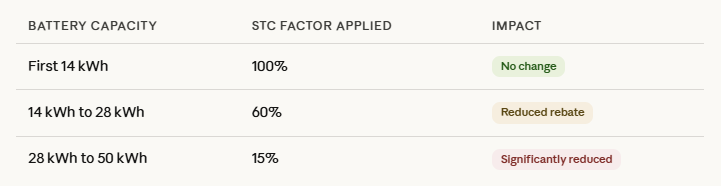
The rebate rate itself is also dropping. Before May it sits at approximately $300 per usable kWh. After May 1 it falls to around $244 per usable kWh, and that rate will step down every six months through to 2030.
Quick example: A 13 kWh battery sitting just under the 14 kWh threshold? You'll see minimal difference. But a household installing a 20 kWh system to cover EV charging and high electricity use could lose thousands in rebate value compared to installing before the deadline.
Who does this actually affect?
If you're looking at a standard 10 to 13 kWh system with average household energy use, the impact is relatively modest. The lower STC rate still applies, but the tiering won't bite you.
But if any of the following apply to you, the May changes are worth taking seriously:
- You have high daily electricity use (air con, pool, electric hot water)
- You're planning to add EV charging
- You want backup power for the whole home overnight
- You're considering a system above 14 kWh
- You've already been thinking about it for months and keep delaying
For these households, installing before 1 May isn't just about savings on paper. It could mean thousands of dollars difference on a system you were going to buy anyway.
"The rebate is determined by your installation date, not when you sign a contract."
The lead time problem
Here's the part most people don't account for: installation timelines.
The Clean Energy Regulator has been explicit. The rebate value is locked in on the date the system is physically installed and commissioned. Signing a contract today does not secure the current rebate. The installation has to happen.
With every other installer in the country having the same conversation with their customers right now, lead times are stretching. We're already seeing 4 to 6 week waits in some areas. If you're planning to install before 1 May, the window to act is now.
The bigger picture
Australia has more rooftop solar per capita than anywhere else in the world. The logic for adding battery storage has never been stronger: feed-in tariffs keep dropping, electricity prices keep rising, and a well-sized battery can cut your bills by $700 to $1,500 per year.
The rebate program exists to lower the upfront barrier, and it still does. But that support is being wound back gradually as battery prices fall and the market matures. May 2026 is the first significant step down. There will be more.
The best time to install was before today. The second best time is right now.
Aussie Solar Batteries is Australia's largest solar battery installer. Get a free quote and find out exactly how much you could save before the 1 May deadline.
Get your free quote today.