The 5 Solar Battery Questions We’re Asked Every Week – Answered.
Over the past few weeks, we’ve had detailed discussions with Whirlpool members and customers about system design, tariffs, product direction and installation timelines.
Today, I’d like to clarify five key topics:
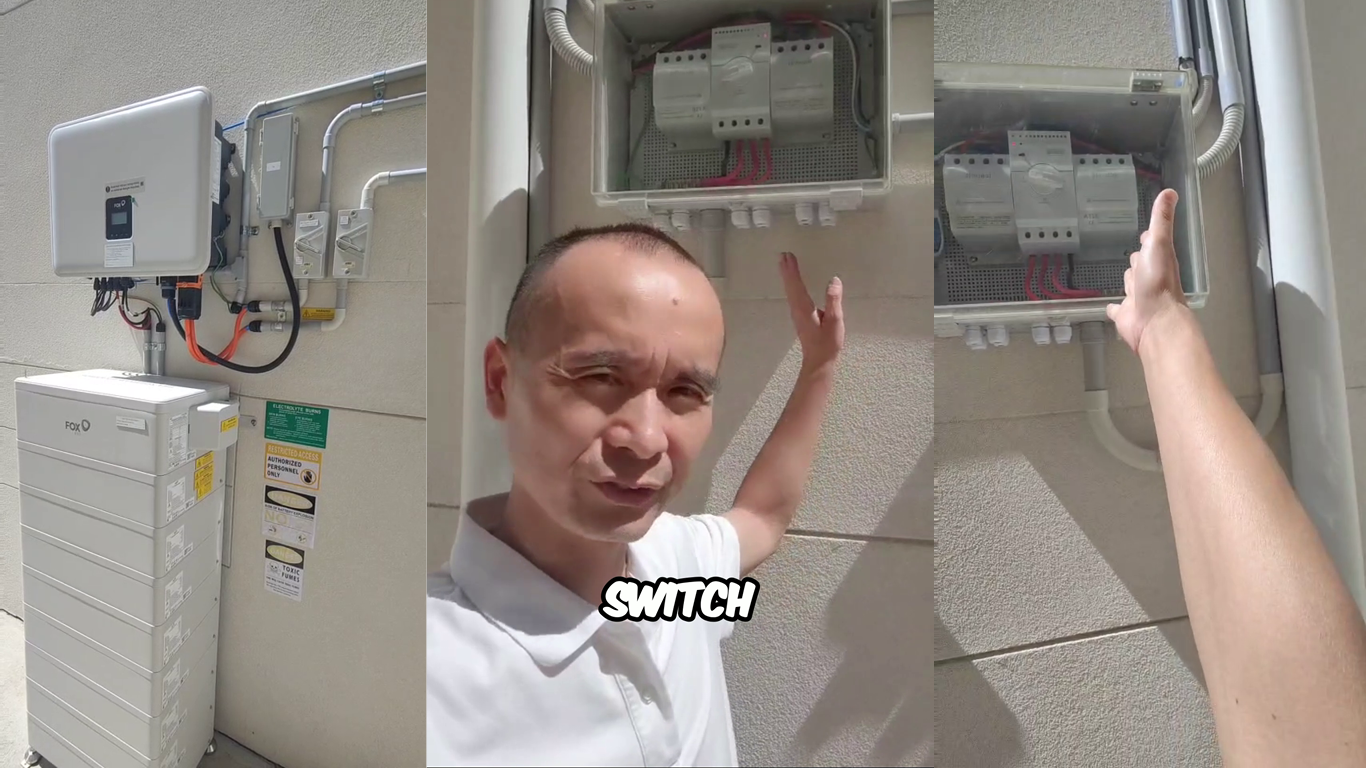
- Control load / off-peak and battery interaction
- Two-phase homes and full PV + battery utilisation
- CQ 6kWh battery situation and future direction
- Globird Energy vs Amber Electric
- ASB order volume and installation progress
— Sunny, Owner, Aussie Solar Batteries
1. Can Control Load / Off-Peak Use PV and Battery?
Short answer: No, not directly.
This is due to wiring and metering configuration.
Case 1 – Two Separate Meters
The grid splits into:
• General meter → main switch
• Control load meter → hot water
If CT is installed before the split, the battery “sees” combined load.
Example:
• Hot water uses 3 kWh
• Battery exports 3 kWh
Your bill shows:
• 3 kWh import (charged ~30–40c)
• 3 kWh export (paid ~3–4c or sometimes negative)
Control load cannot offset battery discharge.
This is the worst financial outcome.
Case 2 – Single Smart Meter with Two Outputs
Grid → smart meter → splits to:
• General load
• Control load
If CT is installed only on general load:
• Battery powers general load
• Control load still uses grid
Best Solutions
Option A – Best (Recommended)
Engage a Level 2 electrician to:
• Remove control load meter
• Move hot water to general circuit
Result:
✔ All loads use PV + battery
✔ No extra daily meter fee
✔ Clean configuration
Option B – Acceptable
• Keep control load meter
• Move loads to main circuit
Result:
✔ PV + battery can supply loads
✖ Still paying control load daily meter fee
2. How Can Two-Phase Homes Use PV + Battery Across All Loads?
It depends entirely on metering.
Situation A – 3-Phase Net Smart Meter
With a 3-phase net smart meter, you can use:
Fox KH single-phase hybrid inverter + 6CT meter
Why it works:
Australian 3-phase smart meters net across phases.
Example:
• Phase A load: 1 kW
• Phase B load: 3 kW
• Battery discharges 4 kW into Phase A
Meter nets:
• Phase A exports 3 kW
• Phase B imports 3 kW
Final result:
👉 Net import = 0
👉 Net export = 0
Effectively both phases use battery power.
Situation B – Two Separate Single-Phase Meters
If you have two independent meters:
❌ Import and export cannot offset
❌ No netting
❌ One phase imports while the other exports
Solutions
Temporary:
• Connect inverter to highest-load phase
Permanent:
Option 1 (Small load):
→ Merge both phases into one
Option 2 (Large load):
→ Upgrade to 3-phase net smart meter
This enables full PV + battery usage across all phases.
3. CQ 6kWh Battery – Product Direction
CQ 6kWh is a transitional product.
My original design was CQ 5.5kWh (120Ah cells) for Fox.
Why?
• 9 modules = 49.5 kWh
• Voltage ≈ 412.5V
• Fully within single-phase inverter limit (480V)
Benefits:
✔ Compatible with single & three-phase inverters
✔ Max 49.5 kWh system
✔ Under 50 kWh subsidy threshold
✔ Faster STC approval
✔ Better installer and dealer cashflow
However, policy changes reduced its advantage before launch.
Under the new policy:
• 5 modules = 27.5 kWh (still strong value)
• 49.5 kWh systems still available for premium customers
Regarding CQ 6kWh:
👉 We will not actively promote it
👉 It is a temporary product
Over the past 6 months, we helped Fox grow from an unknown brand into a recognised top-tier presence in Australia. That reflects our product selection capability, installation quality and system design strength.
4. Globird vs Amber – Which Is Better?
It depends on your system and usage profile.
Globird Energy
• Fixed tariff
• Stable pricing
• Midday free-energy windows
Best for:
✔ Small PV systems
✔ No battery
✔ Customers who want bill stability
Amber Electric
• Wholesale spot pricing
• Can be negative or extremely high
• Supports VPP and automation
Best for:
✔ Large PV system
✔ Battery installed
✔ Customers who can do energy arbitrage
Simple Comparison
- For small PV systems, Globird is generally the better choice.
- If you have no battery, Globird is typically the better option.
- For large solar systems with a battery, Amber is usually the better choice.
- If you prefer a stable, predictable electricity bill, Globird is the better option.
- If you want to trade energy and take advantage of wholesale pricing, Amber is the better choice.
5. ASB Order Volume & Installation Progress
Expansion has been extremely challenging.
We are strong in:
• Sales
• Marketing
• Operations
• Supply chain
The biggest challenge has been installer management.
We currently manage:
• 100+ installation crews nationwide
• 20-person IC supervision team
We:
• Train teams one by one
• Fix issues one by one
• Stop work immediately if standards are not met
After months of optimisation, we now have a much stronger installer network.
Installation Progress
Fast regions:
• Sydney
• Brisbane
• Sunshine Coast
• Gold Coast
Battery-only jobs: Usually completed within 2 weeks
PV jobs: Slightly slower but under control
Delays & Apology
We sincerely apologise to customers in:
• ACT
• South Australia
• Rural NSW
Progress:
• ACT: majority completed
• SA: strong progress
• NSW rural: over 95% completed
We are working to complete all remaining installations before May 1.
To protect subsidy eligibility: We have paused new orders in ACT and SA.
Current Order Volume
We currently receive 400–500 new orders per week.
More than 50% come from referrals. That makes us incredibly proud.
Final Words
We understand the frustration caused by installation delays.
We take full responsibility.
We are working hard to improve:
• Installation speed
• Quality control
• Customer experience
What makes us most proud:
👉 Most customers are satisfied
👉 Many recommend us to friends and family
That is the greatest recognition. We will continue to improve and deliver better service to every customer